Commercial Cleaner Janitor Cleaning: Choosing the Right Vector Art for Your Projects
When you search for "Commercial Cleaner Janitor Cleaning" graphics online, you are likely looking for a clean, professional illustration that captures the hardworking spirit of a janitor or commercial cleaner. The retro style—often black and white, with a front-facing view and an isolated background—is popular for a reason. It is simple, versatile, and works well across many mediums, from T-shirts to greeting cards. But not all vector sets are created equal. Whether you are a small business owner creating merch, a hobbyist making party invitations, or a freelancer designing for clients, you need to know what to look for and what to avoid. This article walks through common mistakes people make when buying or using janitor-themed vector files and how to get the best results every time.
What Is a Commercial Cleaner Janitor Cleaning Vector Set?
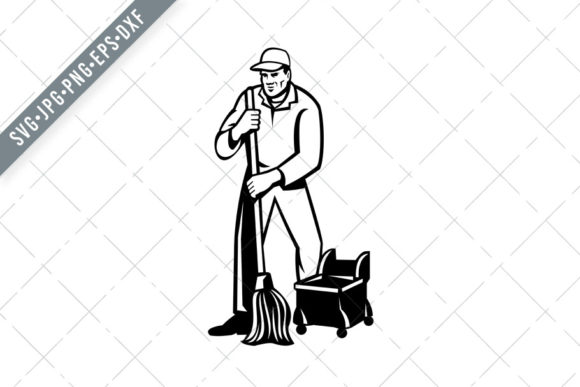
A typical set includes an SVG vector file, a high-resolution PNG (at least 300 dpi and 10 inches or larger), a DXF file, an EPS file, and a JPG file. These formats cover virtually every cutting machine and design software on the market. The SVG works with Silhouette Studio Cameo and Cricut, while the EPS and DXF are useful for professional graphic designers. The PNG and JPG give you ready-to-use images for digital or print projects. The illustration itself usually features a janitor holding a mop, often with a retro or vintage feel, drawn in black and white for maximum flexibility.
Understanding what is included in the download is the first step. Many people assume that all files are interchangeable, but that is not the case. Each format has a specific purpose, and using the wrong one can lead to frustration, wasted time, or poor results.
1. Choosing the Wrong File Format for Your Machine or Software
This is the most frequent mistake. Beginners often download a set and try to open an SVG file in software that does not support it, or they try to cut a PNG on a Cricut without converting it to a cut-friendly format. The result is either an error message or a project that simply does not work.
How to avoid this: Before you buy or download, check what formats your machine or software supports. For example, Cricut Design Space works best with SVG, while Silhouette users often prefer SVG or DXF. If you are using Adobe Illustrator, EPS is ideal. The best vector sets include multiple formats so you can choose the right one. If you are unsure, start with the SVG—it is the most universally compatible across modern cutting machines and design apps.
2. Overlooking Resolution and Size in PNG Files
A PNG file that is only 72 dpi and 500 pixels wide may look fine on a screen, but it will appear blurry or pixelated when printed on a shirt or mug. Many people assume that a PNG is a PNG, but resolution matters enormously. The description should state "300 dpi" and "at least 10 inches" for the PNG. If it does not, the image may not be suitable for professional printing.
Better approach: Always verify the PNG specifications before purchasing. For screen printing, direct-to-garment (DTG) printing, or sublimation, you need a minimum of 300 dpi at the final print size. If the set does not mention this, ask the seller or look for another option. The PNG should be at least 10 inches on the longest side to give you room to scale down without losing quality.
3. Ignoring the Importance of a True Vector Format for Scalability
Some files labelled as "SVG" are not true vectors. They may be raster images saved with an SVG extension, which defeats the purpose. A true vector file allows you to scale the design to any size without losing sharpness. This is critical if you want to print the janitor illustration on a large poster or a small sticker without distortion.
What to check: Open the SVG or EPS file in a vector editing program like Adobe Illustrator, Inkscape, or Affinity Designer. If you can select individual nodes and paths, it is a true vector. If it behaves like a flat image, it is not. Reputable sellers will provide clean, editable vector files that include the original paths.
4. Neglecting to Test the Design on Different Backgrounds
A black-and-white illustration of a janitor mopping may look perfect on a white background, but when you place it on a dark T-shirt or a colored mug, the contrast can be completely lost. Many people do not test their design on the actual surface they plan to use.
Practical advice: Before committing to a large print run, do a test transfer or print. If you are using the SVG for vinyl cutting, check that the lines are clean and that there are no tiny details that will be difficult to weed. For sublimation, ensure the PNG has a transparent background and that the black areas are solid enough to produce good contrast. A retro style illustration often relies on bold lines, which is ideal for this kind of testing.
5. Assuming All "Retro Style" Illustrations Are High Quality
The term "retro" is used loosely in design. Some illustrations are carefully drawn with authentic vintage details, while others are rushed, with uneven lines or poor proportions. If you are selling products to customers, a low-quality graphic will reflect poorly on your brand.
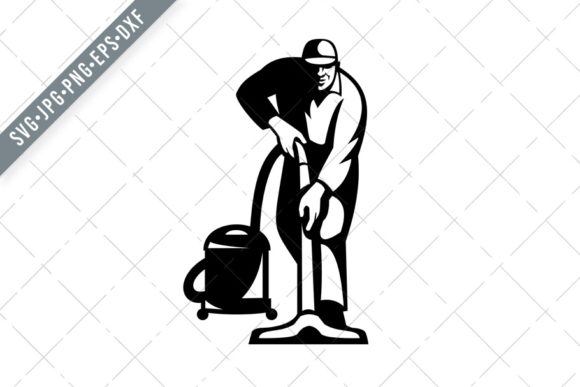
How to judge quality: Look at the preview images closely. Check for smooth curves, consistent line weights, and a balanced composition. The best sets show the front-facing janitor with clear details: the mop head, the clothing, the posture. If the preview looks sloppy, the actual file likely will be too. Also, read reviews or look for seller samples.
Practical Examples of Better Choices
Imagine you are a small business owner creating a line of "Clean Team" T-shirts for a local cleaning company. You find a retro janitor illustration that is black and white, front-facing, and isolated. The set includes an SVG, PNG, DXF, EPS, and JPG. You decide to use the SVG for your Cricut and cut heat transfer vinyl.
Because you checked the resolution, you know the PNG is 300 dpi at 12 inches, so you also have the option to print it directly using sublimation if you want. You test a small sample first. The lines are clean, and the weeding is straightforward. The final shirt looks professional and sells well.
Now consider the opposite approach: you buy a cheaper set that only includes a JPG and a low-resolution PNG. You try to upload the JPG to your Cricut, but the background is not transparent, so you spend an hour trying to remove it manually. The final cut is uneven, and the shirt looks amateurish. The mistake was not just the file format—it was not verifying the contents of the download.
The difference in outcome comes down to understanding what each file type offers and choosing a set that matches your workflow.
What to Check Before You Buy or Download
Before you click "purchase" or "download," take a moment to evaluate these five points:
- File formats included: Does the set have SVG, PNG, DXF, EPS, and JPG? If not, do you have a workaround for the missing format?
- Resolution and size: Is the PNG at least 300 dpi and 10 inches or larger? This ensures print quality.
- Vector integrity: Is the SVG or EPS a true vector? Can it be scaled infinitely without quality loss?
- Design cleanliness: Are the lines smooth and the details clear? Is the illustration visually balanced?
- License clarity: Does the set allow commercial use? Some graphics are for personal projects only. If you plan to sell products, check the license.
By checking these details upfront, you avoid the common pitfalls that lead to wasted time, extra costs, and disappointing results.
How the Right Vector Set Improves Your Projects
When you have a clean, well-prepared vector file, your creative options expand. You can use the SVG to cut vinyl for T-shirts, mugs, stencils, and wall art. The PNG works for digital designs, social media graphics, and print-on-demand products. The EPS and DXF give you flexibility if you switch software or need to share files with other designers. The retro black-and-white style is especially forgiving—it looks good on almost any background and fits themes like cleanliness, hard work, nostalgia, or humor.
For example, a freestanding janitor illustration can be used as a mascot for a cleaning business, a decorative element on a "thank you" card, or a bold print on an apron. The same file, scaled differently, works for both a small sticker and a large banner. That versatility is what makes a well-designed vector set valuable.
Final Thoughts on Choosing Commercial Cleaner Janitor Cleaning Graphics
Whether you are making gifts, starting a small line of apparel, or adding to your design library, the right vector file saves you time and produces better results. Focus on sets that include multiple formats, high-resolution PNGs, and true vector files. Avoid the temptation to go for the cheapest option without verifying the details. Test before you commit, and always think about the final surface where your design will appear.
The retro janitor illustration is a classic design that can work for many audiences. When you choose wisely, you get a file that is ready for anything—from Cricut projects to professional print runs. And that is exactly what you want: a clean start for your next creative project.