One Line Seamless Pattern
When evaluating design assets for textiles, wallpapers, gift wraps, or digital backgrounds, the One Line Seamless Pattern stands out as a distinctive and highly detailed option. This article provides a balanced look at what these patterns offer, when they excel, and when alternatives might better serve your project. Whether you are comparing asset types or deciding on a specific purchase, understanding the characteristics, benefits, and limitations of one-line seamless patterns will help you make an informed choice.
What Is a One Line Seamless Pattern?
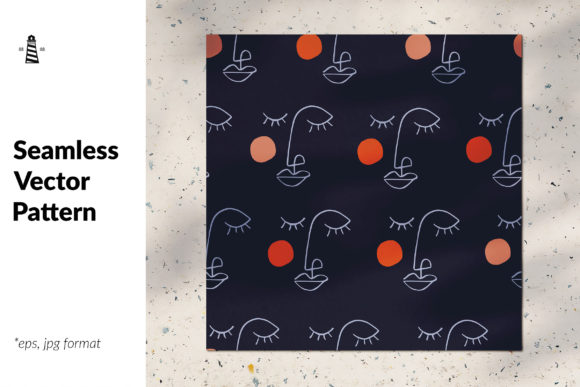
A one line seamless pattern is a repeating design created from a single continuous line that forms recognizable shapes, figures, or abstract motifs. In the context of “seamless pattern with one line faces,” the style focuses on portraits or facial features drawn without lifting the pen – a technique that gives the artwork a fluid, handcrafted feel. The pattern is engineered to tile infinitely without visible seams, making it suitable for full-surface applications. These patterns are typically distributed as vector files (EPS, AI) alongside a high-resolution JPEG (69 x 69 inches at 300 dpi), ensuring both scalability and immediate raster use.
Why Consider a One Line Seamless Pattern?
People exploring one line seamless patterns are often looking for a balance between artistic expression and practical repeatability. The primary draws include:
- Unique aesthetic: The single-line technique gives each face a minimalist yet expressive quality that feels personal and hand-drawn.
- High detail and care: Many of these patterns are carefully hand drawn and then digitized, preserving subtle variations in line weight and organic curves that automated vector art can lack.
- Versatility: Because the artwork is 100% vector and supplied in multiple formats, you can use it for large-format printing (e.g., wallpaper rolls) or scale it down for web page backgrounds without losing quality.
- Instant usability: The inclusion of a 69 x 69-inch JPEG at 300 dpi means you can immediately print or place it without waiting for rasterization or resizing in software.
Benefits
- Scalability without degradation: Vector files (EPS and AI) allow resizing to any dimension while maintaining sharp edges – essential for both a small greeting card and an expansive textile run.
- Seamless repeat certainty: Because the pattern is designed as a seamless tile, you avoid the common headache of aligning edges when creating wraps or continuous backgrounds.
- Recipe for multiple uses: The bundled JPG works as a quick preview for clients or for applications where vector is not required (e.g., web backgrounds or social media posts).
- Distinctive style: One line faces offer a fresh alternative to geometric patterns or photographic repeats, appealing to brands or creatives seeking an artistic, modern look.
Tradeoffs to Consider
- Complexity of design: Hand-drawn one line patterns can be visually busy, especially when repeated across large areas. For minimalist interiors or subtle backgrounds, a simpler pattern may be more appropriate.
- File size: The 69 x 69-inch JPG at 300 dpi results in a very large file (often over 100 MB). While this ensures high print quality, it can be cumbersome to handle in design software or upload to web platforms – you may need to downsample for digital use.
- Cost per pattern: Because these are highly detailed vector art creations, they are typically priced higher than simpler seamless patterns. If your project does not require the hand-drawn, single-line look, you may pay a premium for artistry you do not need.
- Style specificity: The one line face motif is a specific artistic choice. It may not fit corporate, academic, or conservative brand identities where more neutral patterns are preferred.
Practical Expectations: What You Actually Receive
When you acquire a one line seamless pattern described as “high detailed and carefully hand drawn, 100 vector art,” you typically receive:
- 1 EPS file – editable vector with the pattern tile, suitable for Adobe Illustrator and many other vector editors.
- 1 AI vector file – native Adobe Illustrator format, often containing layers or editable paths for customization.
- 1 JPG image – rasterized version at 69 x 69 inches and 300 dpi, ready for immediate preview or use in non-vector workflows.
This combination supports both professional printing and digital deployment. However, note that the EPS and AI files are typically the pattern tile only – you may need to apply the pattern to a larger artboard yourself for your specific application.
When Is a One Line Seamless Pattern a Strong Fit?
- Textile design: The large high-resolution JPG and vector files ensure sharp output on fabric rolls, where detail matters at close viewing distance.
- Wallpaper or large-format wall murals: Because the pattern seamlessly repeats and the vector can be scaled to any wall height, it is ideal for feature walls in residential or commercial spaces.
- Gift paper and wrapping: The artistic, hand-drawn quality adds a premium feel that mass-produced floral or geometric patterns lack.
- Web page backgrounds: The JPG can be cropped or tiled as a background image, and the vector can be exported as an optimized SVG for responsive websites.
- Invitations and greeting cards: The one line face style lends itself to sophisticated, minimalist invitations for weddings, art events, or personal celebrations.
When Alternatives May Be Worth Considering
If your project requires simplicity – for example, a subtle texture that does not distract from content – a one line seamless pattern may be too visually dominant. Consider a simple polka dot, subtle stripe, or a geometric seamless pattern with lower visual density.
If your budget is limited, hand-drawn vector patterns with high detail are often priced higher than automated or photo-based seamless patterns. A cost-effective alternative could be a pattern created from a repeating icon set or a simple abstract vector shape.
If you need photographic realism (e.g., wood grain, marble, or fabric textures), the line art style will not serve that purpose. In those cases, a photographic seamless texture (typically raster) is more appropriate.
If your primary output is small digital graphics (e.g., icons or social media tiles), the 69-inch JPG is overkill, and even a simple SVG or small PNG pattern could be easier to handle and cheaper.
Decision-Making Insights: How to Choose
- Assess your use case: Will the pattern be printed large (wallpaper, fabric) or used digitally? For print, the vector file is critical; for web, you might prefer a smaller raster version. The bundled JPG at 300 dpi delivers both, but you may need to downsample it.
- Evaluate the aesthetic: Does the single-line face motif align with your brand or project theme? Look at sample tiles carefully – some patterns are meticulously hand drawn, others may feel more mechanical. “High detailed and carefully hand drawn” suggests organic variation, but always request a preview.
- Consider the repeat size: A seamless pattern tile can be small or large. The 69 x 69-inch file gives you a very large tile, which on a wall may show the same faces repeated at a large interval – that might be desirable or distracting depending on the effect you want.
- Factor in editing needs: If you need to change colors, add elements, or adjust the line style, the AI file with editable vectors is invaluable. Without it, you are stuck with the pattern as is.
Ultimately, the One Line Seamless Pattern is a specialized asset that shines in projects where hand-drawn artistry, scalability, and seamless repetition are priorities. By weighing its benefits against your specific requirements – the size of your medium, the amount of visual activity you want, and your budget – you can decide if it fits your goals.