The Yin Yang America Symbol: Uniting Opposites in the Star-Spangled Circle
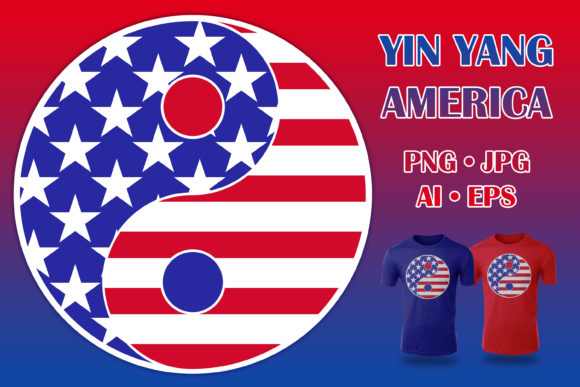
At first glance, the Yin Yang America motif appears as a quiet contradiction—an ancient Taoist emblem fused with the bold stripes and stars of the United States flag. Yet within that paradox lies its deepest truth: the idea that division and harmony are not opposites but partners. The symbol replaces the classic black-and-white teardrops with deep red and navy blue, forming a circular flag that captures the American experiment in a single, balanced frame. For designers, educators, and patriots alike, this visual represents a nation perpetually striving to hold two forces together.
The core design always respects the original Yin Yang geometry. Two interlocking halves create a perfect enclosed circle, each containing a seed of the other. In the Yin Yang America - vector and image collections, the red half carries a tiny blue dot, while the blue half holds a red dot. This micro-detail is not decorative—it communicates that within every strong conviction lies a fragment of its counterpart. The flag patterns weave stars into the curved boundaries, and the stripes flow along the organic S-curve rather than parallel lines. This reimagining transforms a rigid national banner into something fluid, breathing, and conceptually layered.
Why the Yin Yang Circle Symbol Resonates with American Identity
The United States was founded on a series of productive tensions: liberty and law, individual rights and collective good, federal power and state sovereignty. The Yin Yang America circle symbol captures this dynamic better than any static emblem. Unlike a shield or an eagle, which project strength through opposition, the yin-yang form suggests strength through interdependence. The blue half does not dominate the red; each leans into the other, creating a stable whole. For viewers who feel weary of partisan division, the symbol offers a visual truce—not erasing differences but honoring their coexistence.
Professionals in branding and civic design increasingly turn to this motif for campaigns centered on unity. A city government launching a community initiative might use the Yin Yang America - vector and image files to create posters that speak to both liberal and conservative audiences. The symbol does not ask anyone to abandon their colors. Instead, it invites them to see how the other side completes the picture. In focus groups, participants often describe the design as "reassuring" and "non-confrontational"—language rarely associated with political imagery. This emotional response stems from the brain's natural affinity for symmetrical, enclosed forms that suggest resolution.
Practical Applications Across Creative and Professional Fields
The versatility of the Yin Yang America design stems from its availability in multiple file formats. Designers receive .ai and .eps vector files that allow infinite scaling without quality loss. A billboard or a business card can carry the same crisp lines. The .png version with a transparent background layers seamlessly over photographs, textured papers, or masonry walls. For print production, the .jpg at 300 dpi and 4121 x 4121 pixels meets commercial standards for posters, canvas wraps, and large-format displays. The square aspect ratio (1:1) fits Instagram posts, profile images, and grid-based layouts without cropping issues.
Educators find the high-resolution Yin Yang America - vector and image files useful for civics lessons. A high school teacher might project the symbol alongside a Venn diagram of constitutional principles, asking students to identify which "opposites" the red and blue halves represent. University researchers studying political polarization use the image in survey instruments to gauge how visual metaphors influence perceptions of national unity. The 300 dpi resolution ensures that printed classroom materials remain sharp at A3 or tabloid size, even when students examine the tiny star details under magnifying glasses.
- Merchandise and apparel: Screen printers prefer the .eps vector for contour cuts on T-shirts, hoodies, and hats. The enclosed circle works naturally as a chest emblem or sleeve patch.
- Digital content creation: YouTubers and podcasters use the .png as an end-card overlay. The transparent background lets the symbol float over video clips without blocking key visuals.
- Architecture and interiors: Muralists project the 4121 x 4121p .jpg onto walls for hand-painted lobby installations in government buildings and community centers.
- Event branding: Independence day celebrations, unity rallies, and bipartisan conferences adopt the symbol for badges, banners, and digital ticketing assets.
Understanding the Visual Grammar of the Yin Yang USA Flag
To work effectively with the Yin Yang America design, creators should understand its structural rules. The outer circle contains the complete form, meaning the flag elements never spill outside the boundary. Stars appear only along the inner curve of each half, typically seven stars per side—a reference to the original thirteen colonies split across the two domains. The stripes run perpendicular to the S-curve, narrowing as they approach the center line. This creates a visual pulse that draws the eye inward to the small dots, which function as the philosophical anchor of the piece.
The color palette uses official flag red (PMS 193 C) and flag blue (PMS 282 C), ensuring the symbol reads as authentically American next to traditional flag displays. Some variations introduce muted tones for editorial use, but the core Yin Yang America - vector and image library stays true to these standards. For accessibility, the contrast ratio between the two colors exceeds WCAG AA requirements, making the symbol legible for viewers with low vision. This technical attention matters for public-sector applications where inclusivity is mandated.
Hobbyists who craft laser-engraved wooden plaques or CNC-routed signs appreciate the .ai file's layered structure. Each component—outer ring, star field, stripe region, and inner dots—sits on a separate editable layer. A woodworker can isolate the star layer, convert it to a cut path, and reduce engraving time. A digital scrapbooker might delete the stripes and use only the star-and-circle outline as a frame for family photos. The modular nature of the vector file empowers creativity without requiring advanced design skills.
Who Benefits from Using the Yin Yang America Design
Business owners looking to express patriotic values without alienating half their customer base find the symbol uniquely effective. A coffee shop in a politically mixed neighborhood uses the Yin Yang America circle as its seasonal fall logo. Customers on both sides of the aisle report feeling included—the symbol signals respect for diversity of thought, not allegiance to a party. Small business associations have adopted the mark for "Shop Local" campaigns, where the red-blue unity metaphor extends to cooperation between urban and rural merchants.
Creative professionals such as graphic designers, illustrators, and brand strategists incorporate the Yin Yang America - vector and image assets into mood boards and client pitches. The design serves as a conversation starter about dual-brand identity, merging heritage with modernity. A designer proposing a rebrand for a veteran-owned company might place the symbol next to the existing logo to suggest evolution without abandonment. The high resolution and multiple formats reduce production bottlenecks; what begins as a digital mockup can proceed directly to print without re-creation.
Educators and researchers use the symbol as a teaching tool in subjects ranging from political science to art history. In a classroom discussion of semiotics, the Yin Yang America circle demonstrates how cultural symbols evolve by borrowing from unrelated traditions. A sociology professor might ask students to compare public reactions to this design versus a traditional flag. The exercise reveals how shape alone—circular versus rectangular—changes emotional perception. Researchers studying national identity have used the image in peer-reviewed studies, noting that its balanced composition reduces cognitive bias compared to asymmetrical symbols.
Hobbyists and DIY enthusiasts access the files for personal projects that celebrate American heritage in non-traditional ways. A quilter might print the .jpg at full 4121 x 4121 resolution to create a fabric panel for a patriotic quilt. A 3D printer enthusiast can import the .eps into CAD software and extrude the symbol as a wall clock or decorative medallion. The asset's clarity at large sizes means even a twenty-inch print retains the star details. Online communities share modifications—adding state outlines, replacing the stars with local landmarks, or converting the design into a coloring page for children.
Technical Considerations When Using the Vector and Image Assets
Working with the Yin Yang America - vector and image files requires some awareness of format behavior. The .ai file opens natively in Adobe Illustrator and preserves all vector paths, gradient meshes, and embedded color profiles. Users of Affinity Designer or CorelDRAW should request the .eps version, which maintains compatibility across vector editing suites. The .png file uses 24-bit color with 8-bit alpha transparency, making it suitable for web use where file size matters. At 4121 x 4121p, the .jpg compresses to a manageable 4–6 MB while retaining enough data for offset printing at 300 dpi.
For those printing the Yin Yang America symbol on fabric or textured media, the .ai file includes a color separation guide. This layer shows how the red and blue halves break into spot colors, reducing ink waste during screen printing. The 300 dpi .jpg works well for dye-sublimation on polyester substrates, where the high resolution prevents banding in the curved stripe areas. Sign makers appreciate that the outer circle diameter equals exactly half the image width, allowing easy centering on standard 24x24 inch or 48x48 inch substrates.
Digital implementation is equally straightforward. Web developers can use the .png as a favicon, a social media avatar, or a navigation icon. Because the design is square and enclosed, it scales down to 32x32 pixels without losing recognizability. Email marketers have tested the symbol as a call-to-action button—the red-blue contrast draws clicks at rates comparable to standard orange or green buttons. The circular format stands out in lists of rectangular thumbnails, creating visual variety that improves engagement metrics.
Why This Symbol Represents a New Visual Language for Patriotism
Traditional flag imagery often emphasizes verticality—stripes rising, stars arrayed in rigid rows. The Yin Yang America circle symbol breaks this convention by introducing rotation, curvature, and embrace. Patriotic expression shifts from confrontation to conversation. The design does not wave; it rests. It does not point; it encloses. For a generation that values authenticity and nuance, this visual vocabulary resonates more deeply than static heraldry. The symbol acknowledges that unity does not mean uniformity; it means two distinct energies choosing to coexist.
In commercial stock libraries, the Yin Yang America - vector and image category continues to grow as demand increases for politically neutral yet identifiably American graphics. News outlets covering election cycles use the image for "common ground" segments. Nonprofits focused on civic dialogue incorporate it into workshop materials. The design appears on graduation announcements, wedding invitations, and memorial programs—occasions where family members with different beliefs gather under a single roof. The symbol does not erase differences; it frames them as part of a larger, beautiful whole.
The choice of blue and red is deliberate and grounded in color psychology. Blue conveys stability, trust, and depth—qualities associated with institutions, law, and tradition. Red conveys energy, passion, and courage—qualities linked to change, voice, and action. When these colors form a Yin Yang America circle, they suggest that a nation needs both structure and fire to endure. The small dots inside each half reinforce the message: no side is pure; every perspective contains a grain of its opposite. This philosophical maturity makes the symbol suitable for contexts where simple cheerleading feels insufficient.
As the United States continues to navigate its identity in the twenty-first century, visual symbols that embrace complexity will become more valuable than those that insist on simplicity. The Yin Yang America design offers a rare combination: aesthetic elegance, conceptual depth, and practical versatility. Available in .png, .ai, .eps, and .jpg formats at 300 dpi and 4121 x 4121p, the files meet the needs of professionals and amateurs alike. Whether applied to a billboard in Times Square or a lapel pin at a town hall meeting, the symbol carries the same message: we are two halves of one circle, and our unity is not despite our differences but because of them.