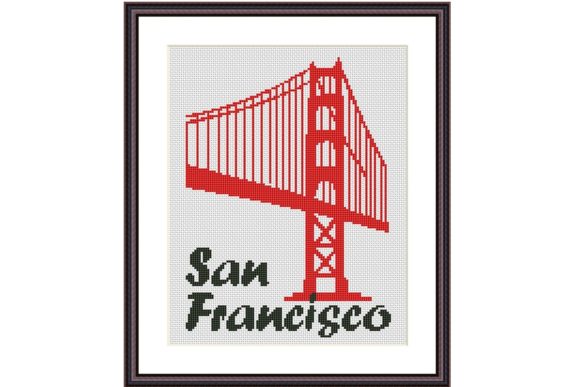
San Francisco City Cross Stitch Pattern
Every graphic designer knows that the most memorable visual identities are built on carefully chosen details. When you bring San Francisco City Cross Stitch Pattern into your creative toolbox, you’re not just adding another embroidery guide—you’re gaining a modular, pixel-precise design asset that can inform everything from brand iconography to patterned backgrounds. This cross stitch pattern uses only full stitches, making it equally approachable for beginners and experts. The clean geometry of full crosses creates a natural pixel grid that mirrors the logic of digital design, where every thread corresponds to a square on a grid. For designers working on branded merchandise, packaging patterns, or social media graphics, this pattern offers a tactile, handcrafted aesthetic that stands out in a sea of vector-only visuals.
Why a City Skyline Pattern Belongs in Your Creative Assets
Cross stitch patterns have long been a source of design inspiration, but the San Francisco city cross stitch pattern stands apart because of its compositional clarity. The skyline silhouette, rendered entirely in full stitches, produces a strong visual hierarchy that works at multiple scales. Whether you’re using it as a repeating element in packaging design or as a hero graphic for a travel-themed editorial layout, the pattern’s consistent stitch count ensures predictable proportions. For brand identity projects, this pattern can be adapted into a monochrome icon system or used as a texture overlay in UI design. The accompanying PDF (8 pages) includes a main image, a key, color and symbol patterns, and four larger color-symbol pages for comfortable work—an organizational structure that any design project manager would appreciate.
Practical Applications Across Media
The versatility of the San Francisco city cross stitch embroidery design extends beyond fabric. In digital marketing, you can use the pattern to create authentic-looking mockups for social media banners or email headers. For print design, it works beautifully as a spot illustration on business cards or as a full-bleed pattern on notebooks. Because the pattern only requires full crosses, it translates easily into pixel art for web design or even as a user-generated content template for brand challenges. Designers working on packaging for local artisan goods can use the skyline as a subtle embossing pattern, adding a premium tactile element that reinforces brand storytelling.
When evaluating creative assets, consistency is key. This pattern comes with a clear color palette and symbol legend, making it easy to integrate into your existing brand system. The four expanded pattern pages allow for comfortable large-format work, but the same digital files can be scaled down for smaller branding elements. For editorial design, the grid structure lends itself to modular layout systems—you can isolate individual building stitches and repurpose them as icons for a travel magazine column.
Enhancing Visual Communication with Stitch-Based Design
Modern aesthetics often blend digital precision with handmade warmth. The San Francisco city cross stitch pattern achieves this balance by turning a classic craft into a repeatable graphic element. In UX design, the pattern’s grid logic can inspire icon grids or data visualization mockups. For social media graphics, the pixelated skyline gives a retro-futuristic vibe that resonates with audiences drawn to nostalgic design trends. The full-stitch requirement means no fractional stitches, so you can scale the design without worrying about broken lines or uneven tessellation.
Typography also benefits from cross-stitch inspiration. You can pair the pattern with clean sans-serif fonts for a contemporary brand ID, or use it alongside hand-lettered scripts for a craft-market appeal. The key page in the PDF acts like a design system legend, showing exactly how each color maps to a symbol—similar to how a style guide outlines hex codes and typography hierarchy. This attention to detail makes the pattern a teaching tool for junior designers learning about color mapping and symbol systems.
Tips for Integrating Cross Stitch into Design Workflows
- Scalability: Because full stitches form a perfect grid, you can resize the pattern in vector software using nearest-neighbor interpolation for a crisp pixel look. This works well for web design icons or app buttons.
- Color Reduction: Use the pattern’s color palette as a starting point for a limited brand palette. The embroidery key shows which colors appear most, helping you prioritize hues in your branding.
- Mockup Versatility: Import the pattern into Photoshop or Illustrator to create realistic product mockups—tote bags, wall art, or textile labels—without stitching a single thread.
- Brand Consistency: Treat the skyline silhouette like a logo. Its recognizable form works as a repeating pattern for packaging or as a standalone mark for merchandise.
By approaching this cross stitch pattern as a design asset rather than just a craft instruction, you unlock its potential for professional presentation. The 8-page PDF is structured for efficiency: one overview image, one key page, two standard pattern pages, and four expanded pages for detailed work. This layout mirrors the way design files are organized—separating technical specs from creative comps. For brand identity projects, you can even use the color-symbol pages as a visual reference for internal style guides.
Closing Thoughts on Thoughtful Design Choices
Whether you’re a graphic designer seeking fresh creative assets or a business owner building a visual brand from scratch, incorporating a structured pattern like the San Francisco city cross stitch pattern into your workflow pays dividends. Its full-stitch simplicity ensures both beginners and experts can reproduce it faithfully, while its skyline composition offers immediate geographic and cultural context. When you choose a design element that balances consistency with character, you elevate your brand communication beyond the ordinary. Let this pattern remind you that sometimes the most powerful visual tools are those that look handmade but are built with systematic precision—exactly what modern design demands.